RECOMMEND SOLUTIONS


RELATED PRODUCTS
Four-Faith Wind Turbine Blade Health Monitoring Solution
Date:2026-06-16 15:11:36
Enabling Safe, Efficient, and Intelligent Wind Farm Operations
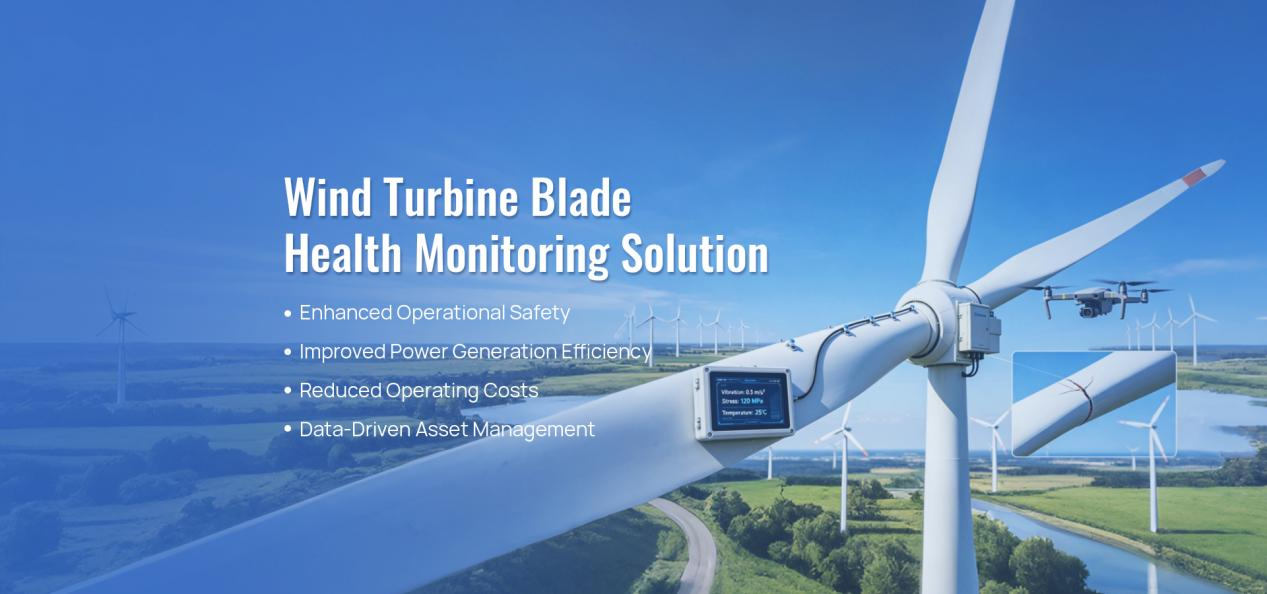
As a key pillar of clean energy, wind power generation is entering a period of rapid large-scale development. Wind turbine blades, as the core components responsible for capturing wind energy, operate continuously in harsh outdoor environments characterized by high altitudes, strong winds, extreme temperature fluctuations, and severe electromagnetic interference. Over time, they are susceptible to structural damage, abnormal vibrations, excessive temperatures, and other risks that can directly threaten turbine safety and power generation efficiency.
To address these challenges, Four-Faith integrates wireless communication, multi-sensor perception, edge computing, and big data analytics technologies to develop a comprehensive Wind Turbine Blade Safety and Health Monitoring Solution. Through an intelligent closed-loop architecture of "Sensing – Transmission – Analysis – Early Warning – Maintenance", the solution enables 24/7 visibility, measurement, and control of blade conditions, helping wind farms improve operational efficiency, reduce costs, and ensure safe and stable power generation.
Industry Pain Points
- Safety Risks
Wind turbine blades are continuously exposed to cyclic loads and extreme weather conditions, making them vulnerable to cracks, deformation, lightning damage, and other defects. Traditional manual inspections often fail to identify issues in a timely manner, increasing the risk of catastrophic incidents such as blade breakage and turbine collapse.
- Low Maintenance Efficiency
Conventional inspections rely on climbing operations, suspended platforms, and telescopic observation equipment. These methods are labor-intensive, time-consuming, and hazardous. Moreover, inspections often require turbine shutdowns, resulting in power generation losses and increased maintenance expenses.
- Data Silos and Monitoring Challenges
Due to the difficulty of installing cables between turbine blades and nacelles, wired monitoring systems are hard to deploy. This leads to discontinuous data collection and unstable transmission, making it difficult to obtain real-time information on blade loads, vibrations, temperatures, and other critical operating parameters.
- Reactive Decision-Making
Without lifecycle data accumulation and intelligent analysis, fault diagnosis largely depends on human experience. This limits the ability to perform predictive maintenance, early fault detection, and precise fault localization, resulting in delayed maintenance responses and reduced operational continuity.
Solution Overview
To address these challenges, Four-Faith has developed a Wind Turbine Blade Safety and Health Monitoring Solution based on Wi-Fi networking technology, designed to meet the wind power industry's demands for safety, efficiency, and intelligent operations.
Featuring a wireless, cable-free deployment architecture and edge-cloud collaboration, the solution enables rapid installation without complex construction work, providing real-time blade condition monitoring, intelligent fault warnings, and blade lifespan prediction.
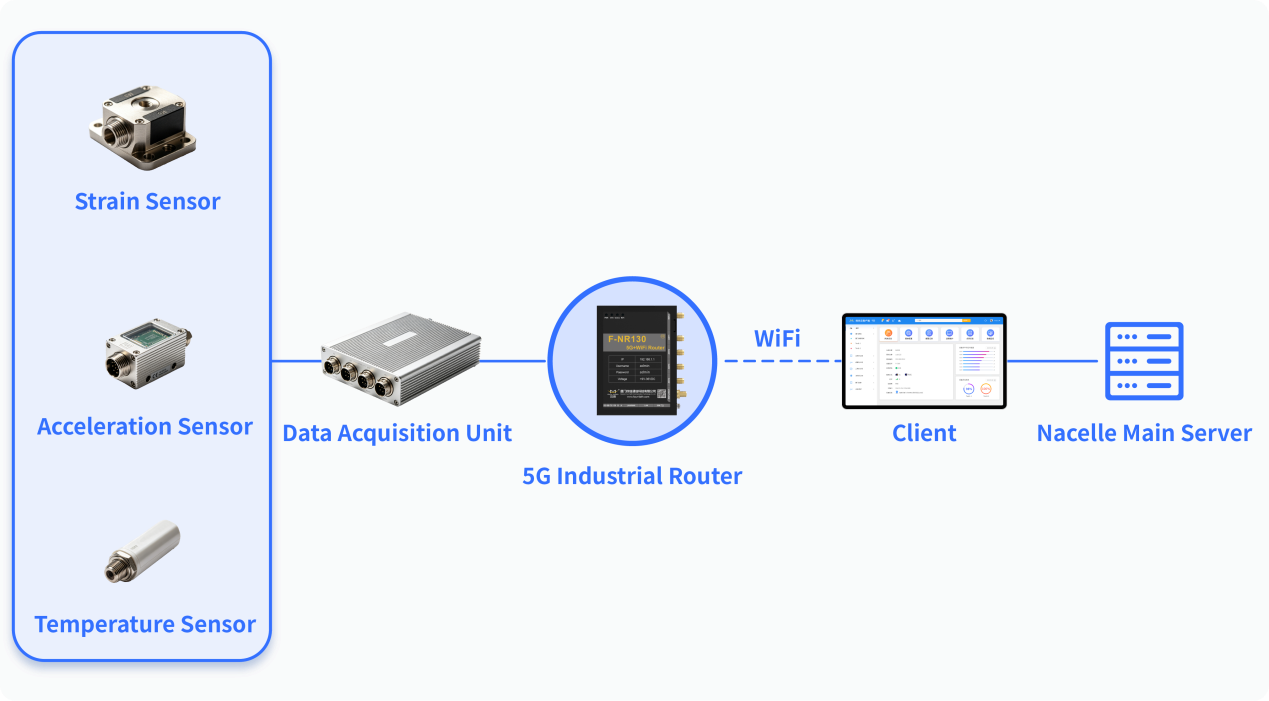
- Perception Layer
High-precision resistance strain gauges or fiber optic strain sensors are installed at critical load-bearing locations of wind turbine blades, including the blade root, mid-section, and tip. These sensors measure strain under different operating conditions to evaluate structural stress and deformation.
In addition, highly sensitive accelerometers are mounted on blade surfaces to collect vibration acceleration signals. Through signal processing and integration, key vibration parameters such as frequency, amplitude, and phase can be obtained.
Temperature sensors are deployed both inside and on the surface of blades to monitor thermal conditions and environmental changes. Temperature data serves as an auxiliary parameter for comprehensive blade health assessment.
- Transmission Layer
A Wi-Fi-based wireless communication network is used to reliably transmit monitoring data to the data processing center.
Wi-Fi Access Points (APs) are deployed inside the turbine nacelle. Sensor data is transmitted wirelessly to the nacelle AP and then forwarded through the wired network to the wind farm's core switch before being aggregated and sent to the monitoring center server.
To ensure network stability and reliability, multiple AP redundancy deployment and channel optimization technologies are adopted, effectively eliminating signal interference and coverage blind spots while ensuring continuous and reliable data transmission.
- Data Processing Layer
The nacelle data processing server receives monitoring data from the transmission layer and performs storage, preprocessing, and analysis.
Data Storage
A dedicated database is established to store historical monitoring data for long-term retrieval, comparison, and analysis.
Data Preprocessing
Raw data undergoes filtering, noise reduction, amplification, and analog-to-digital conversion to improve accuracy and data quality.
Data Analysis
Advanced analytics software and algorithms are used to extract blade condition indicators such as:
- Strain peaks
- Vibration spectra
- Damage area estimation
- Structural health indicators
These parameters are compared with predefined thresholds to determine blade operating conditions.
Furthermore, predictive models are established to estimate the remaining useful life (RUL) of blades, providing data-driven support for maintenance planning and asset management.
Solution Benefits
- Enhanced Operational Safety
Replace hazardous manual high-altitude inspections with 24/7 online blade condition monitoring.
Real-time threshold alarms can be integrated with wind farm control systems to automatically adjust turbine operating status or initiate shutdown procedures, preventing severe accidents such as blade failure.
- Improved Power Generation Efficiency
Timely detection of blade icing, imbalance, and other abnormal conditions allows intelligent pitch control or optimized shutdown strategies to minimize power losses.
Data-driven load optimization recommendations help operators fine-tune turbine parameters and maximize annual energy production.
- Reduced Operating Costs
The solution significantly reduces costs associated with:
- Drone inspections
- Elevated work platforms
- Manual tower climbing
Annual maintenance costs per turbine can be reduced by more than 40%.
Predictive maintenance based on lifespan forecasting helps avoid both over-maintenance and under-maintenance while extending blade service life.
- Data-Driven Asset Management
All monitoring data is visualized on cloud platforms, enabling remote access to blade health trends and historical alarm records.
Big data analytics supports the establishment of a blade fault knowledge base, providing valuable insights for future blade selection, design optimization, and operational improvements.
Recommended Product
5G Industrial Router F-NR130-02
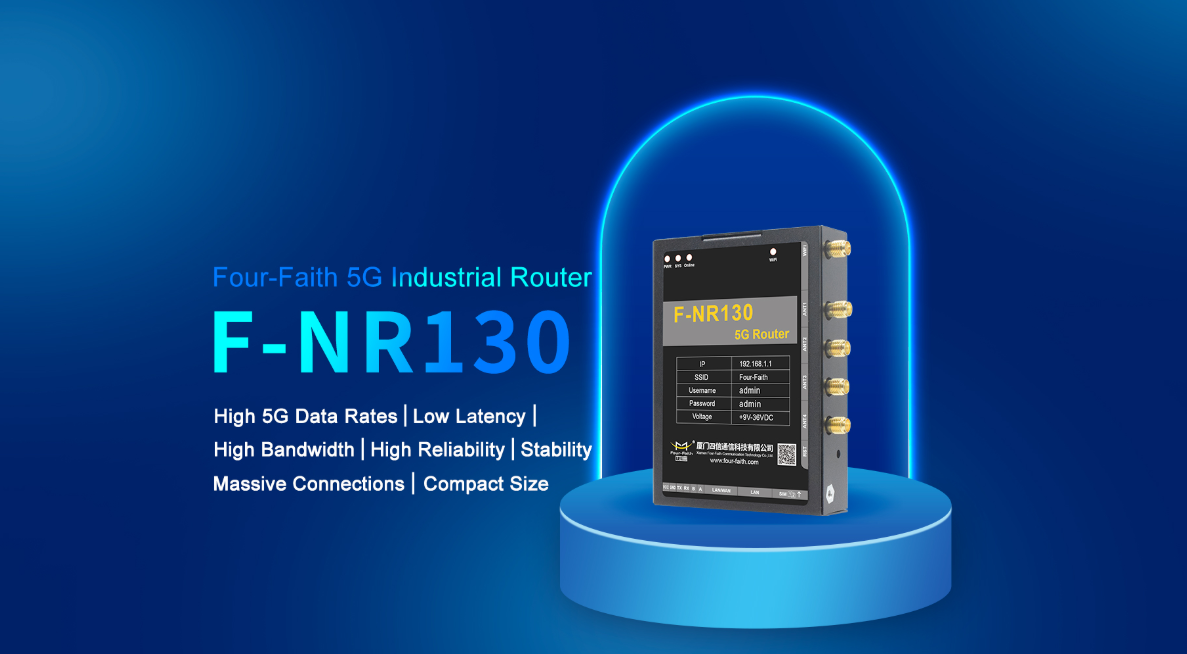
The Four-Faith F-NR130-02 5G Industrial Router is specifically designed for demanding environments such as wind power and Industrial IoT applications, serving as the core communication device within the blade monitoring system's transmission layer.
- Rugged and Reliable
- Operating temperature: -35°C to +75°C
- Wide power input range: DC 9–36V
- EMC protection compliant with National Standard Level 3:
- ESD protection
- EFT protection
- Surge protection
- Hardware and software watchdog mechanisms
- Anti-disconnection protection for stable 24/7 unattended operation
- High-Speed Dual-Band Wi-Fi
- Supports 2.4GHz and 5.8GHz dual-band Wi-Fi
- Built-in band-pass filters for interference suppression
- Reliable wireless communication performance
- Up to 500 meters transmission distance in open line-of-sight environments
- Measured packet loss rate on 5.8GHz network: approximately 0.01% (1 packet per 100,000)
- Fast Roaming
- Roaming recovery time between APs is less than 100 ms (client mode)
- Compatible with access points from any vendor
- Ensures seamless wireless coverage across nacelle and blade monitoring areas
- Rich Interfaces
- 2 × Gigabit Ethernet Ports
- 1 × RS232 Port
- 1 × RS485 Port
Direct connectivity to various strain, vibration, and temperature acquisition modules.
Supports intelligent switching between 5G/4G cellular networks and wired networks to adapt to different wind farm communication environments.
- Cloud-Based Management
- Supports Four-Faith Cloud remote management
- Real-time monitoring of device status, signal strength, and data usage
- Supports multiple VPN protocols
- Ensures secure and reliable data transmission
Wind Turbine Blade Health Monitoring Solution
From Perception to Prediction, From Monitoring to Intelligent O&M
Empowering Wind Farms with Safer Operations, Higher Efficiency, and Lower Lifecycle Costs.
TAGS: Wind Turbine Blade Health Monitoring Solution [Previous Page]
Previous Page:5G CBRS Private Network Empowers Multi-Scenario Intelligent Surveillance Solutions
next page:last_page